Mother’s Day Silhouette Vector Set
A Designer’s First Look: Clean, Quiet, and Full of Heart
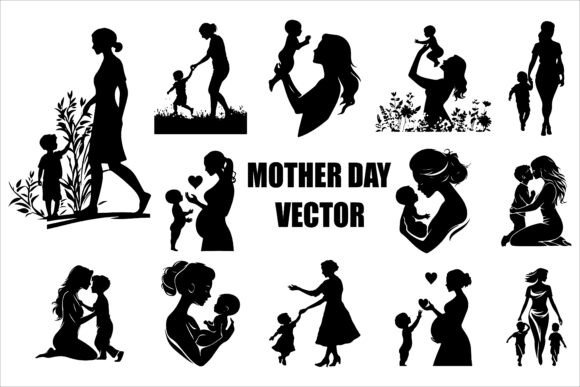
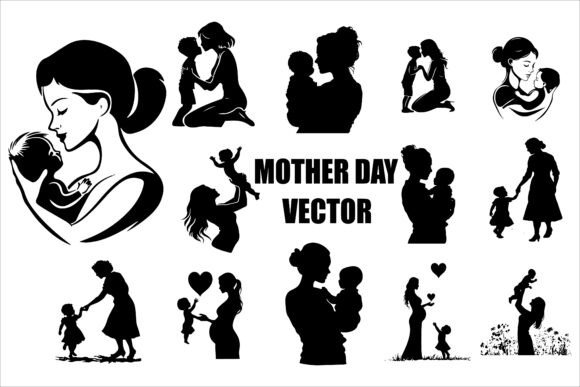
When I opened the Mother’s Day Silhouette Vector Set, my first thought wasn’t “cute” or “trendy”—it was “calm.” Thirteen silhouettes—mothers holding children, cradling babies, standing side-by-side with arms around shoulders—each drawn with gentle curves, balanced negative space, and no fussy details. This isn’t a design shouting for attention. It’s one that breathes quietly in the background of a handmade pillow cover, nestles softly on a baby onesie, or anchors a minimalist tote bag with quiet confidence. As a designer who’s stitched hundreds of client projects, I appreciate how rare it is to find vector art that feels both emotionally resonant *and* technically embroidery-ready.
How It Translates to Real Embroidery Projects
I tested three silhouettes across different applications: a medium-sized design (approx. 4.5" wide) on a cotton twill tote bag, a smaller version (3") on a lightweight baby bodysuit, and a simplified outline-only version on a denim cap. In every case, the clean lines held up beautifully. Because the shapes rely on contour rather than internal detail, they convert cleanly into satin stitch borders or smooth fill-stitch areas—no jagged edges, no fragile interior loops that collapse under dense stitching.
This set shines brightest on custom apparel and soft home goods: sweatshirt embroidery where subtlety reads as sophistication, tea towels where simplicity avoids visual clutter, nursery decor where gentle imagery supports calm spaces, and embroidered patches meant for aprons or backpacks. For Etsy sellers and small shop owners, these silhouettes lend instant warmth to listings—especially when paired with neutral thread colors like heather gray, oatmeal, or soft navy. They don’t compete with fabric texture; they complement it.
Where to Use It Thoughtfully
That said, not every surface welcomes silhouette work equally. On stretchy fabrics like jersey or ribbed knits, I recommend using light- to medium-weight cutaway stabilizer—and testing hoop tension first. The outlines are generous enough to hold shape, but thin threads or loose weaves can cause subtle waviness without proper support. On dark fabric, avoid pale thread unless you’re intentionally going for low-contrast elegance; darker thread (charcoal, deep rust, forest green) gives stronger definition and better giftability.
For curved surfaces—caps, baby hats, or rounded pillow covers—I’d simplify further: choose the most open, unbroken silhouettes (like the mother-and-child side profile) and avoid those with tight inner corners or overlapping limbs. Those fine junctions can blur during hooping or stitching, especially at smaller sizes. And while this set works well for machine embroidery design, it’s not ideal for tiny hoop sizes under 3". There’s simply not enough interior detail to justify scaling down—so save it for 3.5" and larger applications where the gesture reads clearly.
What It Adds to Your Finished Product—Beyond Stitching
Here’s what surprised me: how much this set elevates perceived value. A plain cotton kitchen towel becomes a meaningful holiday embroidery piece. A basic black sweatshirt transforms into a thoughtful personalized gift—not because the design is flashy, but because it feels intentional, human, and unhurried. Customers notice that. As an Etsy seller, I’ve watched listings with similarly quiet, confident designs outperform busier alternatives in Mother’s Day searches—especially among buyers aged 35–55 who prioritize authenticity over novelty.
It also supports brand consistency. Whether you’re building a craft business around mindful gifting or curating a boutique line of nursery essentials, these silhouettes reinforce a cohesive visual language: warm, grounded, and respectful of quiet moments. They don’t distract from your craftsmanship—they frame it.
Practical Notes Every Embroidery Designer Should Keep Handy
- Always test on scrap fabric first—especially with textured weaves or blends. What looks clean in vector form may shift slightly once stitched.
- Review stitch density before sending to your machine. Simpler silhouettes often need less fill, so adjust underlay and density to avoid stiffness on lightweight items like baby clothes.
- Confirm hoop size early. These files scale well, but the original vector proportions suggest best results between 3.5" and 5.5" for most apparel and home goods.
- Inspect small details in your embroidery software—check for stray anchor points or unintentional overlaps in layered SVG or EPS files.
- Test black-and-white mockups to see how contrast holds up across fabric tones. Some silhouettes read better on light backgrounds; others gain presence on charcoal or olive.
- Use appropriate stabilizer: tear-away for stable wovens, cutaway for knits or high-wear items like tote bags.
- Verify licensing terms before selling finished products or bundling the digital embroidery file into kits. The listing says “commercial applications,” but always double-check scope—especially if you plan to offer printable mockups or digital product previews.
Final Thought: A Design That Lets the Moment Speak
The Mother’s Day Silhouette Vector Set doesn’t try to say everything. It says just enough—and leaves room for the person holding the finished product to feel something real. That’s why it works so well for handmade product creators: it supports intention without overshadowing it. Whether you’re stitching a last-minute gift for your own mom, building a seasonal collection for your craft business, or designing a limited-run embroidered patch for a local boutique, this set delivers clarity, warmth, and quiet professionalism. It’s not flashy—but in the world of Crafts and Graphics, sometimes the most powerful designs are the ones that simply hold space, gracefully.